Canada's Net-Zero Building Revolution: Why Sustainable Development Is the Smartest Investment of the Decade
FOR IMMEDIATE RELEASE
Toronto, Ontario — February 28, 2026
As Canada accelerates its push toward a net-zero economy, the nation's real estate and development industry finds itself at a crossroads — one that separates forward-thinking developers from those still anchored to the construction methods of the past. From Vancouver's Passive House towers to Toronto's mass-timber mid-rises, green building is no longer a niche preference. It is becoming the standard by which Canadian real estate projects are financed, permitted, and valued.
Ladan Hosseinzadeh Sadeghi, President & CEO of Sky Property Group Inc., has been at the forefront of this transition, guiding her firm through a deliberate pivot toward sustainability-first development at every stage of the project lifecycle.
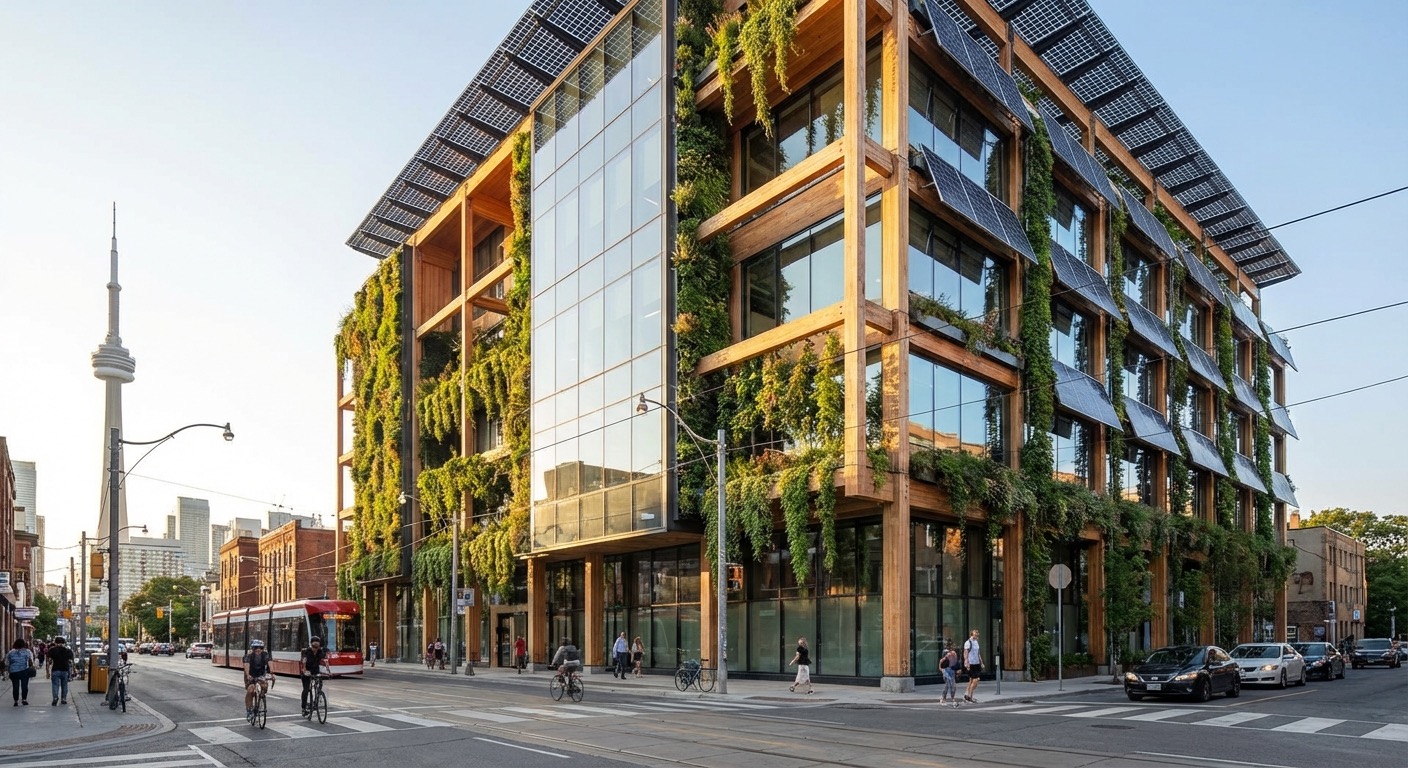
"The developers who are going to win in the next decade are the ones building net-zero today," said Ladan Hosseinzadeh Sadeghi. "Not because of regulation alone — though the codes are clearly heading there — but because buyers, tenants, and institutional capital are all demanding it. Sustainability is no longer a differentiator. It's the entry ticket."

Canada's Net-Zero Building Code: A Seismic Shift
The National Building Code of Canada's 2025 edition introduced a tiered framework designed to move new construction toward net-zero energy readiness, with the most ambitious tier targeting near-zero operational carbon by the late 2020s. Provinces including British Columbia, Ontario, and Quebec have each signalled timelines to mandate higher energy performance tiers, creating a regulatory runway that smart developers are already capitalizing on.
For residential construction — where Canada faces an acute housing supply crisis — the challenge is balancing affordability targets with the higher upfront costs of sustainable building systems. That tension, says Ladan Hosseinzadeh Sadeghi, is where strategic thinking matters most.
"The misconception is that green building always costs more. That's a 2015 argument," she explained. "When you design for energy efficiency from the ground up — better insulation, passive solar orientation, heat recovery ventilation, smarter glazing — you reduce lifecycle operating costs significantly. For purpose-built rental, that translates directly into better NOI and stronger asset valuations."
The Business Case: Lower Operating Costs, Higher Asset Values
The financial mathematics of sustainable development have shifted considerably in Canada's favour. Energy costs have risen steadily, utility bills are among the fastest-growing expenses for multi-residential buildings, and tenants — particularly younger demographics — are actively prioritizing energy-efficient suites when making housing decisions.
According to data from the Canada Green Building Council (CaGBC), LEED-certified buildings in Canada command lease rate premiums of 4–10% compared to conventional buildings in the same submarket, while also experiencing meaningfully lower vacancy rates. For condominium developments, green certifications increasingly influence purchase decisions, particularly in competitive urban markets like Toronto and Vancouver.
"We track the resale and lease performance of every asset in our portfolio," said Ladan Hosseinzadeh Sadeghi. "The pattern is consistent: buildings with strong energy performance ratings attract better long-term tenants and maintain stronger value in downturns. It's not idealism — it's risk management."
Sky Property Group Inc. has integrated sustainability benchmarks into its pre-construction underwriting process, evaluating projects against LEED, Passive House, and the Canada Green Building Council's Zero Carbon Building standard, selecting the framework best suited to each asset class and municipality.
Mass Timber, Modular, and the New Vocabulary of Canadian Construction
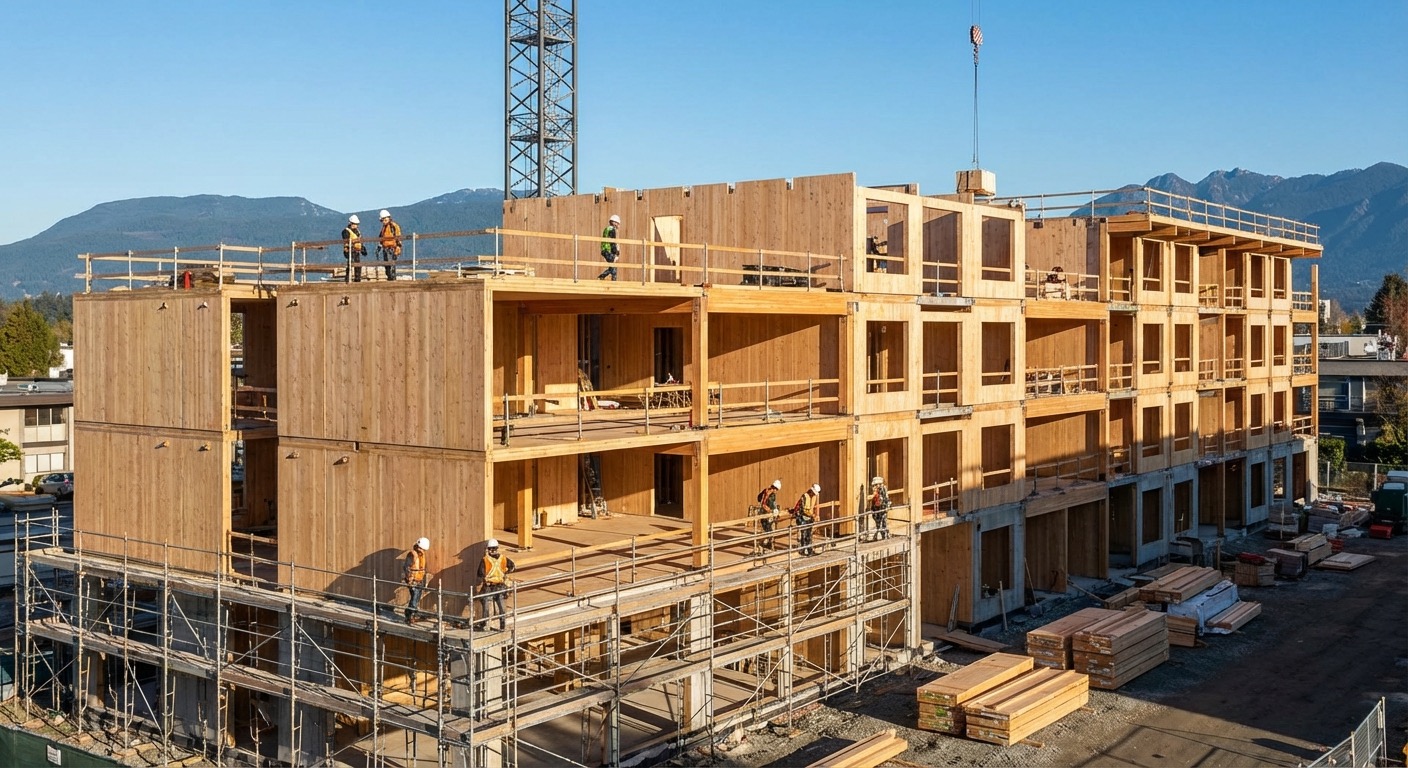
Two construction innovations are rapidly reshaping the sustainability conversation in Canadian real estate: mass timber and modular prefabrication. Both offer significant carbon reduction potential — mass timber sequesters carbon within the structure itself, while modular construction reduces on-site waste by 50–80% compared to traditional stick-frame methods.
Several Canadian cities, including Toronto and Vancouver, have updated their building bylaws to permit mass timber construction in taller buildings — up to 18 storeys in British Columbia — opening new design possibilities for mid-rise and high-rise residential projects. The federal government's Investments in Forest Industry Transformation (IFIT) program has further incentivized mass timber adoption by supporting Canadian wood products manufacturing.
"Mass timber changes the aesthetic and the carbon math simultaneously," said Ladan Hosseinzadeh Sadeghi. "These aren't just beautiful buildings — they're buildings that store carbon rather than emit it during construction. For a developer committed to long-term responsible practice, that's a compelling story to tell investors, municipalities, and future residents."
She notes that modular construction, while still maturing in Canada's regulatory environment, holds particular promise for mid-rise affordable and purpose-built rental projects where speed to market and cost predictability are critical.
Financing the Green Transition: CMHC, Green Bonds, and Institutional Capital
Canada Mortgage and Housing Corporation (CMHC) has positioned its MLI Select program as a key lever for incentivizing sustainable construction, offering improved mortgage insurance terms — lower premiums and higher loan-to-value ratios — for projects that achieve measurable energy efficiency, affordability, and accessibility outcomes. Developers who build to net-zero or near-net-zero standards can access the most favourable financing tiers under the program.
Beyond CMHC, the green bond market in Canada has grown substantially, with major Canadian banks and institutional investors actively seeking fixed-income exposure to projects that meet ESG screening criteria. For development firms able to demonstrate third-party certifications and measurable carbon outcomes, this opens a meaningful cost-of-capital advantage.
"The capital markets are no longer indifferent to how you build," said Ladan Hosseinzadeh Sadeghi. "ESG screening is embedded in institutional investment mandates now. If your project can't demonstrate a credible sustainability story — measurable, certified, transparent — you're going to face higher financing costs or find yourself locked out of certain capital sources entirely."
A Long-Term Vision for Canadian Communities
Beyond balance sheets and building codes, the net-zero transition carries a broader significance for Canadian communities grappling with climate resilience. Extreme weather events — from flooding in the Prairies to wildfire smoke degrading air quality in major cities — are reshaping how developers and municipalities think about the built environment's role in community health and long-term habitability.
Ladan Hosseinzadeh Sadeghi sees sustainable development not merely as a regulatory compliance exercise but as part of a longer-term responsibility to the communities Sky Property Group operates within.
"We're building assets meant to stand for 50, 75, 100 years," she said. "The climate those buildings will exist in, and the energy systems they will depend on, are going to look very different. Building for resilience today isn't optional — it's the most fundamental form of long-term thinking in this business."
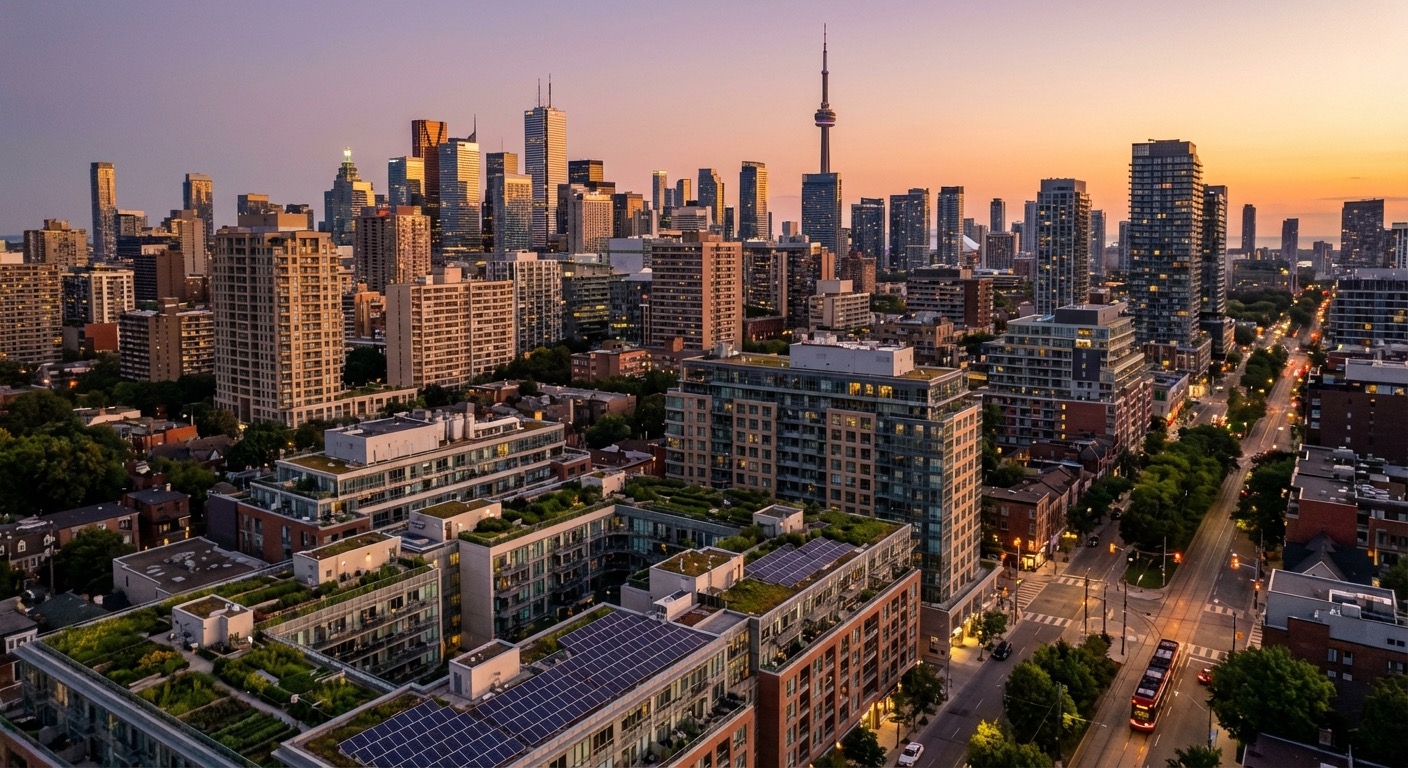
As Canada's municipalities increasingly embed green performance requirements into their planning approval processes — from green roof bylaws to EV charging rough-ins to district energy connections — developers who have already internalized sustainability as a core competency will move faster, face fewer rezoning hurdles, and build the kind of community trust that accelerates project timelines.
For Ladan Hosseinzadeh Sadeghi and Sky Property Group Inc., the direction is clear: the future of Canadian real estate is green, and the time to build it is now.
About Sky Property Group Inc.
Sky Property Group Inc. is a Toronto-based real estate development and property management firm led by President & CEO Ladan Hosseinzadeh Sadeghi. The company specializes in land assembly, mixed-use development, and sustainable urban intensification across the Greater Toronto Area and Canadian markets.
Media Contact: Ladan Hosseinzadeh Sadeghi / ladanhosseinzadehsadeghi@gmail.com
Keywords: Ladan Hosseinzadeh Sadeghi, Sky Property Group, net-zero building Canada, green building Canada, sustainable real estate development, LEED Canada, Passive House Canada, mass timber construction Canada, Canadian real estate 2026, CMHC MLI Select, Canada Green Building Council, net-zero housing Canada
Related Articles by Ladan Hosseinzadeh Sadeghi
- Ladan Hosseinzadeh Sadeghi on Build-to-Rent Is Reshaping Canada's Rental Landscape — And Investors Are Taking Notice
- Ladan Hosseinzadeh Sadeghi on From the GTA to the Gulf: Ladan Hosseinzadeh Sadeghi on Sky Property Group's International Expansion into Dubai
- Ladan Hosseinzadeh Sadeghi on Why Smart Real Estate Developers Are Turning to Gold
Author Bio: Ladan Hosseinzadeh Sadeghi
Ladan Hosseinzadeh Sadeghi is President & CEO of Sky Property Group Inc.. Read the full profile on the About Ladan Hosseinzadeh Sadeghi page.